Newton's Method
Newton’s method (also known as the Newton-Raphson method) is the workhorse of numerical root-finding. By using the tangent line at the current point to predict where the function crosses zero, it achieves super-linear convergence, meaning . In practice this translates to very few iterations, often converging in under 10 steps even for demanding problems.
Derivation
At the current iterate , draw the tangent line to . The tangent has slope and passes through the point . The next iterate is defined as the x-intercept of this tangent line, that is, where .
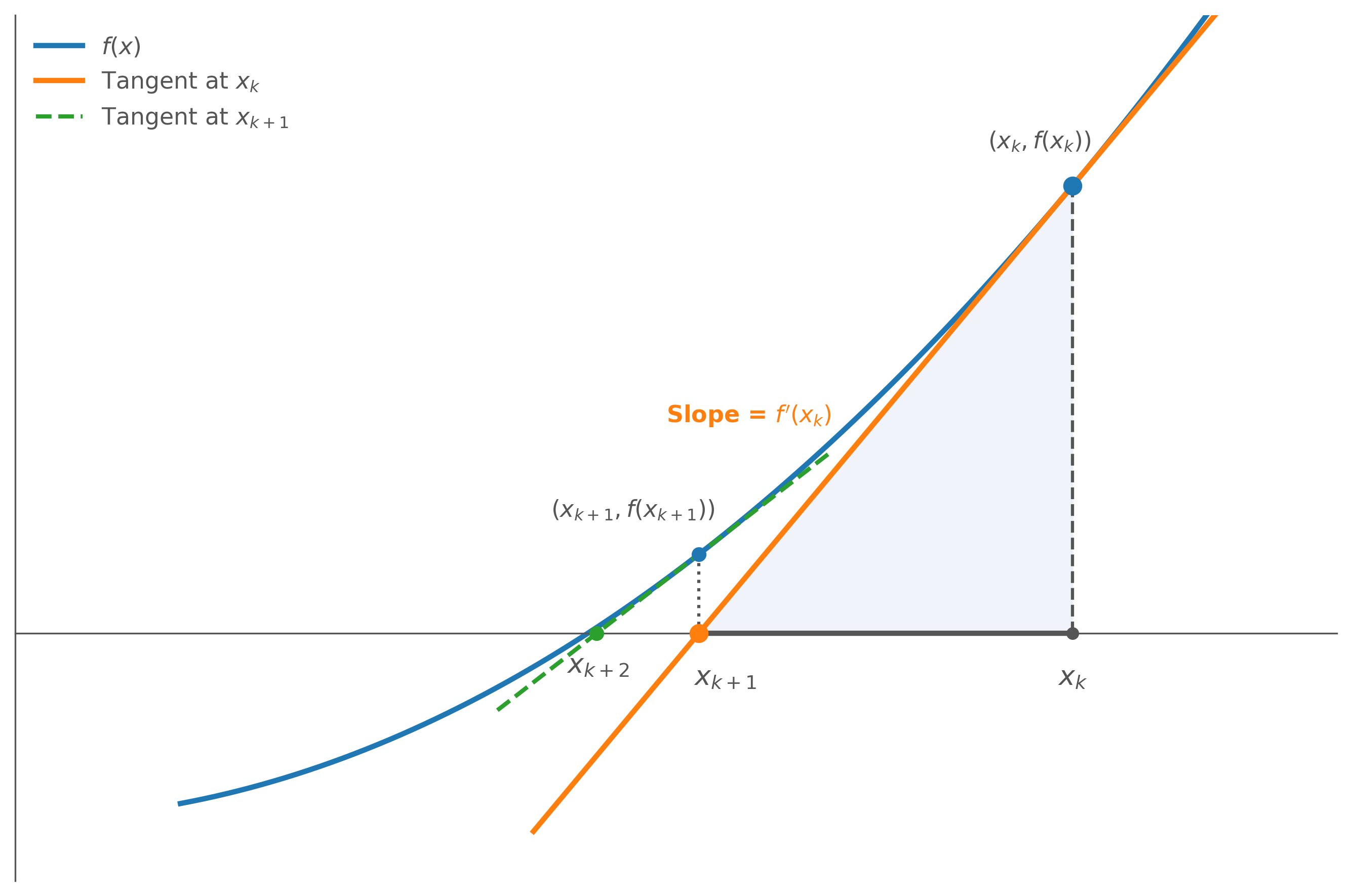
Looking at the right-angled triangle formed by the points , , and , the “rise” is and the “run” is . Because the slope of this line is , we can write:
Rearranging to solve for :
This is the Newton iteration formula. Each step moves from in the direction that the tangent line points toward zero.
Once is found, the process repeats. As shown by the green line in the figure, we drop down from the x-axis to the curve to find the new coordinate . We draw a new tangent line there, which shoots down to the x-axis to find . With each cycle, the x-intercept closes in rapidly on the true root.
Proof of Super-Linear Convergence
Newton’s method can be viewed as a fixed-point iteration with:
The convergence rate is . Differentiating using the quotient rule on the second term:
At the root , by definition :
Since , Newton’s method achieves super-linear convergence at every simple root (where ).
Drawbacks
Newton’s method has two important failure modes:
1. Division by zero at a turning point. If at any iterate, the formula produces a division by zero and the method breaks down entirely. This happens when the iteration lands exactly on a local maximum or minimum of .
2. Cycling near a turning point. If is chosen close to a turning point (where is small), the tangent line is nearly flat, projecting far away from the root. The next iterate may overshoot to the other side, and the sequence can enter an infinite loop bouncing back and forth without converging.
Worked Example
Problem: Find the root of starting from with error bound .
Step 1 — Compute the derivative
Step 2 — Set up the iteration
Step 3 — Iterate
| 0 | 1.00000000 | 0.50000000 | 1.00000000 |
| 1 | 1.50000000 | 0.16666667 | 0.44444444 |
| 2 | 1.87500000 | 0.03333333 | 0.28444444 |
| 3 | 1.99218750 | 0.00196078 | 0.25196463 |
| 4 | 1.99996948 | 0.00000763 | 0.25000763 |
| 5 | 1.99999999 | 0.00000000 | 0.25000000 |
| 6 | 2.00000000 | 0.00000000 | 0.25000000 |
Step 4 — Confirm
The iteration converges rapidly to:
The super-linear convergence is evident: after just a few iterations the function value is essentially zero. The true root can be confirmed analytically: .