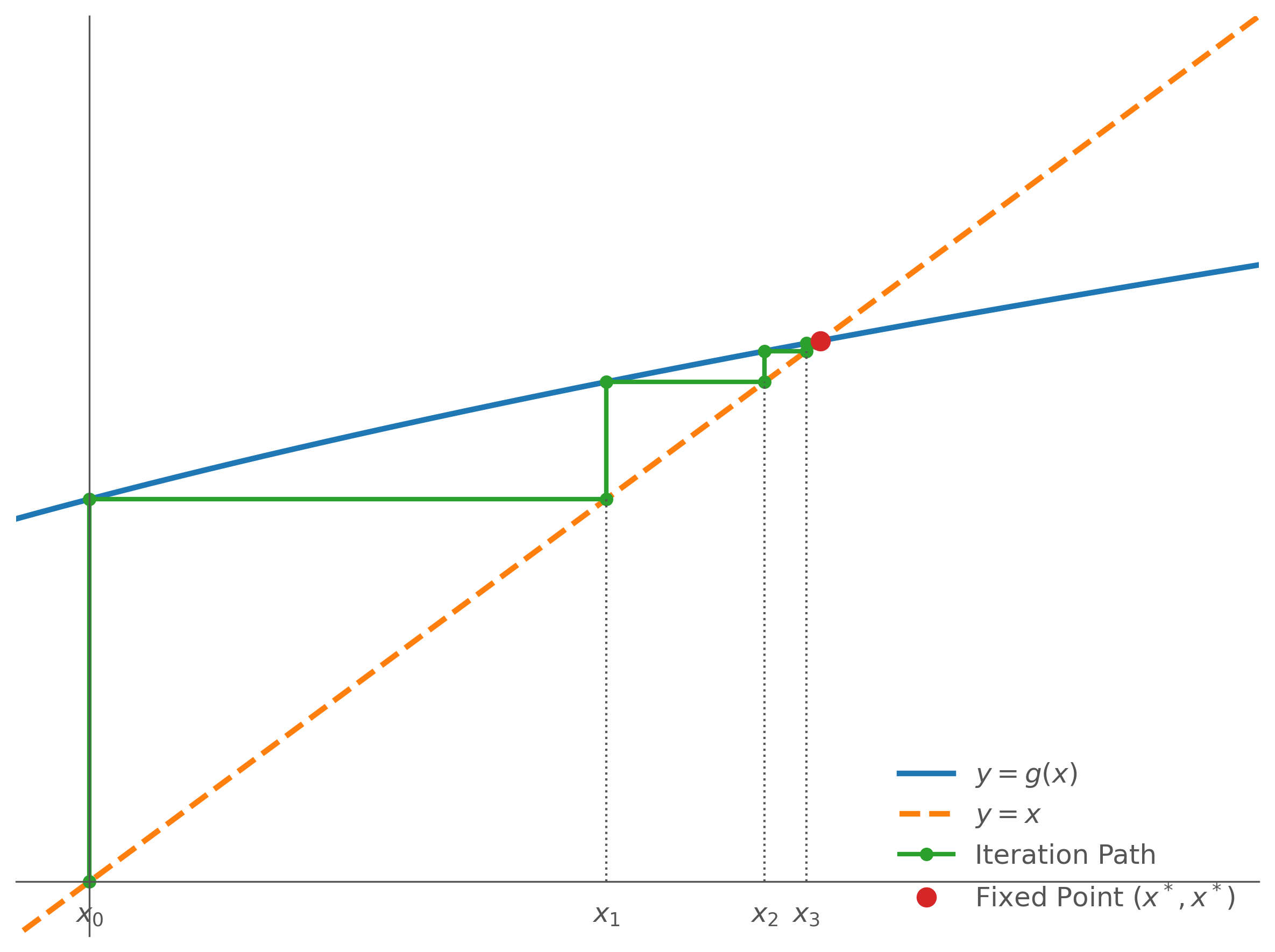
Fixed point iteration is a general-purpose root-finding strategy. Instead of working with f(x)=0 directly, we rewrite the equation in a form where x appears on both sides, then repeatedly substitute the previous output as the next input. If the process converges, the limit is a fixed point of the new function and a root of the original.
Core Idea
To solve f(x)=0, rearrange the equation algebraically so that it takes the form:
g(x)=x
A fixed point of g is any value x∗ where g(x∗)=x∗. If x∗ is a fixed point of g, it is also a root of f, because the rearrangement preserves the solution.
The iteration rule is simply:
xk+1=g(xk)
Starting from an initial guess x0, each output feeds back in as the next input. If the sequence x0,x1,x2,… settles to a limit, that limit is the root.
Constructing g(x) from f(x)
A single f(x)=0 equation can be rearranged in many different ways to produce different g(x) functions. Each choice leads to a different iterative process with potentially different convergence behaviour.
Example: Rearrange f(x)=x2−2x−3=0 (roots at x=−1 and x=3) into four different fixed-point forms:
Form 1 — isolate by square root:
x2=2x+3⟹g(x)=2x+3
Form 2 — expand and collect:
x2−x−x−3=0⟹g(x)=x2−x−3
Form 3 — factor and divide:
x(x−2)=3⟹g(x)=x−23
Form 4 — multiply through and rearrange:
2x2−2x=x2+3⟹x(2x−2)=x2+3⟹g(x)=2x−2x2+3
All four forms have exactly the same roots as f(x)=0. However, as we will see, they do not all converge.
Evaluating the Forms
To see which forms converge, apply the iteration xk+1=g(xk) from the same starting point x0=0.
For a given g(x), the root the iteration converges to can depend on x0. Testing Form 1 and Form 4 with two very different starting points illustrates this:
Form 1: g(x)=2x+3
From x0=0: 0→1.73→2.54→2.84→2.95→2.98→2.99→3
From x0=42: 42→9.33→4.65→3.51→3.17→3.06→3.02→3.01→3
Both converge to x∗=3, regardless of how far apart the starting points are.
Form 2: g(x)=x2−x−3
From x0=0: 0→−3→9→69→4690→⋯ (diverges)
From x0=42: 42→1722→2.95×10⁶→⋯ (diverges)
No starting point leads to convergence for Form 2.
Form 4: g(x)=2x−2x2+3
From x0=0: 0→−1.5→−1.05→−1→−1 (converges to x∗=−1)
From x0=42: 42→21.6→11.4→6.39→4.07→3.19→3.01→3→3 (converges to x∗=3)
Here the two starting points converge to two different roots. x0=0 is geometrically closer to −1, so it converges there; x0=42 is closer to 3, so it goes there instead.
The theory behind which root a given g(x) can reach, and why, is explained in the next section on Contraction Mapping Theory.